DUI Defense
Protect your rights with experienced guidance through every step of your DUI case.
DUI Basics
What is a DUI?
In Washington State, a person can be charged with Driving Under the Influence (DUI) in two primary ways:
Per Se DUI: This is based strictly on numbers. If your Blood Alcohol Concentration (BAC) or Breath Alcohol Concentration (BrAC) is .08 or higher (or .02 for minors, or 5.00 nanograms or higher of THC for marijuana) within two hours of driving, you are considered "per se" intoxicated, regardless of how sober you may feel or act.
Affected-By DUI: Even if your BAC/BrAC is below the legal limit, or if you refuse the breath test, the government can charge you if they can argue your ability to operate a motor vehicle was "affected by" alcohol, drugs, or a combination of both. This focuses on your physical manifestations, driving patterns, and performance on tests.
What are the penalties?
Washington has some of the harshest DUI laws in the country. Penalties are governed by a complex sentencing grid that fluctuates based on your BAC level and whether you have prior offenses within the last seven years.
Mandatory Minimums: Even for a first-time offender with a low BAC, the law requires a minimum of 24 consecutive hours in jail, a 90-day license suspension, and significant fines.
Maximum Penalties: A standard gross misdemeanor DUI carries a maximum of 364 days in jail and a $5,000 fine.
Electronic Home Monitoring (EHM): In many cases, the court may impose EHM in addition to, or occasionally in lieu of, certain jail segments.
Sentencing Grid: You can view the most recent Washington State DUI Sentencing Grid here to see exactly what you are facing based on your specific circumstances.
Should I do the Standardized Field Sobriety Tests (SFSTs)?
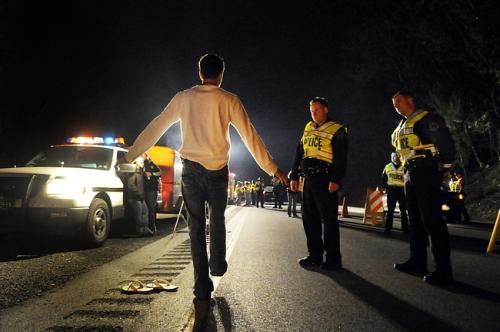
No. Never. The roadside "tests"—walk and turn (WAT), one-leg stand (OLS), and horizontal gaze nystagmus (HGN). They are designed for you to fail. They are subjective tools used by police officers to build "probable cause" to arrest you. You have a legal right to politely decline these tests, and doing so deprives the prosecution of evidence they would otherwise use against you in court. There is no score at which you are deemed to have "passed" the SFSTs, so there is no tangible benefit to you in taking them.
What will happen to my license?
It is vital to understand that you are facing two separate battles:
The Criminal Case: Handled in court, which deals with jail time and criminal records.
The DOL Administrative Case: Handled by the Department of Licensing (DOL).
When you are arrested for DUI, the DOL will move to suspend your license automatically. You only have 7 days from the date of your arrest to request a DOL Hearing to contest this suspension. If you miss this window, your license will be suspended regardless of what happens in your criminal court case.
Should I agree to do the breath test at the station?
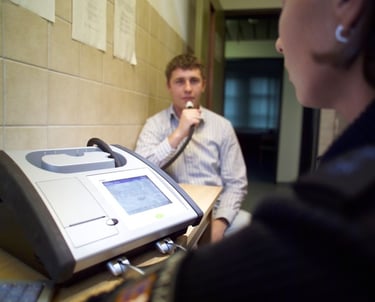
This is a critical decision, and the "right" answer depends entirely on your specific history and whether this is your first interaction with the law. A refusal can lead to a longer license revocation, but providing a high BAC reading can lead to mandatory minimum jail time and higher fines.
Before you blow, call Bulldog Law. You have a right to speak with an attorney before deciding. Call Bulldog Law immediately at 425-405-0506. We are available to give you the advice you need when every second counts.
Should I speak to the police?
No. Aside from providing your license, registration, and insurance, you should remain silent. Anything you say "can and will be used against you." You cannot talk your way out of a DUI arrest, but you can certainly talk your way into a conviction.
As a reminder of why silence is your best friend, watch this classic defense breakdown on why you should "Shut the Fuck Up."
Standardized Field Sobriety Tests
For years Jared has been exposing the lack of statistical underpinnings for the National Highway Traffic Safety Administration (NHTSA) approved battery of Standardized Field Sobriety Tests (SFSTs). There is no way to pass the SFSTs. And the only study that has been done with sober people taking the SFSTs shows that they fail them too.
Beyond that, despite endorsing the SFSTs, NHTSA never intended them to be used as they are. NHTSA in their own studies concluded that there is no connection between impaired driving and performance on the SFSTs.
Draeger Breath Testing
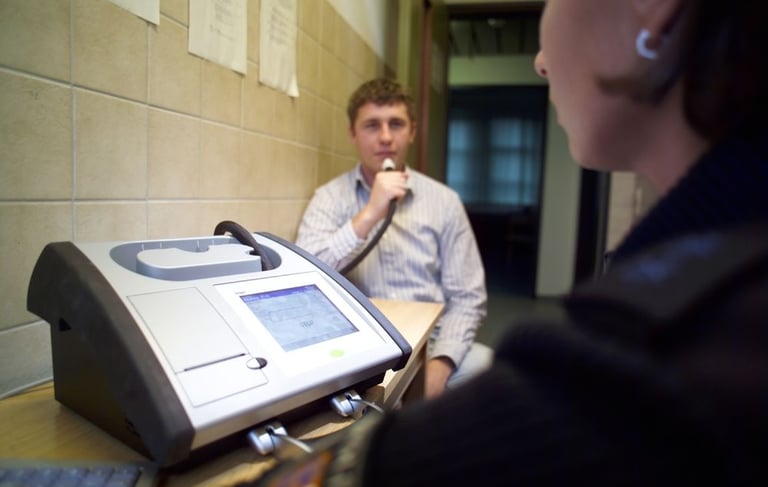
Jared spent years working with experts, litigating, and exposing breath testing in Washington State. WSP uses the Draeger Alcotest 9510 for its breath testing, but the software and algorithms the machine uses have never been shared with WSP or the public.
1721 Hewitt Ave
Suite 600
Everett, WA
Phone
425-405-0506